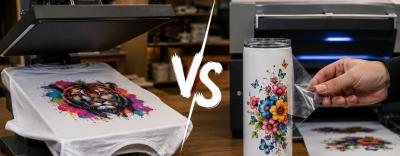
Spend any time scrolling through TikTok or YouTube Shorts lately, and you’ll notice a pattern. Someone is peeling a transfer off a film, pressing it onto a product, and within seconds a full-colour design appears like it took almost no effort at all. The caption usually says something along the lines of “no heat press needed anymore” or “this is the future of printing.”
It looks simple enough that many beginners assume they’ve finally found an easy entry point into a printing business. No complicated setup, no heavy machinery, just print and stick.
But what often gets lost in those short clips is context. And that missing context is exactly where most of the confusion in today’s DTF and UV DTF market begins.
People are not just misunderstanding a product. They are misunderstanding two completely different production systems that happen to share a similar name.
That misunderstanding is quietly responsible for a lot of wasted investment, wrong equipment purchases, and failed first attempts at starting a print business.
To really understand why this keeps happening, you have to step back from the hype and look at how these technologies actually behave in real production environments.
Why “DTF” Has Become a Misleading Shortcut Online
In the printing industry, Direct to Film has been around long enough to be considered a stable production method for garment decoration. It is widely used for clothing, uniforms, promotional wear, and small batch custom apparel.
But online content has blurred the line between traditional DTF and UV DTF. Creators often show UV DTF processes and label them simply as DTF, which sounds harmless at first but leads to a very different expectation of how the system works.
The result is predictable. Beginners assume one system can do everything. Fabric, glass, plastic, wood. Shirts, mugs, packaging. All with one setup and no additional tools.
That assumption rarely survives contact with real production.
In actual workshop environments, these are two separate workflows built for different materials and different physical requirements. One relies heavily on heat and pressure. The other relies on UV curing and adhesive layering. They may look similar on camera, but they behave nothing alike once you start producing at scale.
Traditional DTF Still Works in a Very Specific Way
Traditional DTF printing is still fundamentally a textile-focused process. It exists to solve a problem that older printing methods struggled with, especially when it came to printing on darker fabrics or mixed materials.
In practice, it follows a structured workflow that does not change just because social media simplifies it.
A design is first prepared digitally with transparent backgrounds. The artwork is then printed onto PET film using specialised inks. A layer of white ink is added behind the colours to ensure visibility on dark garments.
At this stage, the print is still fragile. It is not ready for use yet.
The next step involves applying adhesive powder while the ink is still wet. That powder is not optional or decorative. It is the bonding layer that determines whether the final transfer will survive washing and daily wear.
Once applied, the powder is heat-cured. This is where many online videos start skipping details, even though this stage is critical for long-term durability.
Finally, the design is transferred onto fabric using a heat press. This is where both temperature and pressure come into play. Without controlled pressure, the ink layer cannot properly bond to fibres, which leads to early peeling or cracking after washing.
In real production environments, pressure consistency is often discussed more than temperature. That surprises beginners, but experienced users know that uneven pressure is one of the fastest ways to ruin a batch of prints.
The Overlooked Role of Pressure in Print Quality
One of the most common misconceptions among newcomers is assuming that temperature is the only important factor in heat transfer work.
In reality, pressure plays a similar level of importance in DTF printing. A perfect temperature setting with weak pressure still produces poor results.
This becomes especially obvious when working with thicker garments, seams, or textured fabrics. If pressure is not evenly distributed, certain areas of the transfer may bond correctly while others fail, creating inconsistencies that only appear after washing.
This is also why experienced operators tend to be very specific about their heat press setup. Not all machines behave the same under load, and automatic systems sometimes fail to deliver the same level of pressure stability that manual systems provide.
It is not a theoretical concern. It is something that shows up in production output.
UV DTF Enters the Picture and Changes the Expectation
UV DTF is where most of the confusion actually starts.
Unlike traditional DTF, this system is designed for hard surfaces rather than fabrics. The entire process is built around UV-curable inks and adhesive film layers instead of heat bonding into textiles.
The key difference is not just the material. It is the entire application logic.
There is no heat press stage. Instead, the design is printed, instantly cured under UV light, laminated, and then transferred onto a solid surface using adhesive pressure alone.
This is why viral videos often emphasise “no heat press needed.” They are technically correct in the context of UV DTF, but the problem is that viewers rarely realise this distinction is specific to that system alone.
Without that clarification, it is easy to assume UV DTF replaces traditional garment printing, which it does not.
Why UV DTF Works So Well for Hard Surfaces
UV DTF has become popular in the personalised product market for a simple reason. It removes several steps that people associate with traditional print workflows.
There is no powdering stage. No curing oven in most setups. No heat pressing onto fabric.
Instead, the process focuses on adhesion to non-porous surfaces. Glass, acrylic, coated plastics, metal finishes. These are all areas where UV DTF performs strongly when used correctly.
This makes it especially attractive for small gift businesses and custom product sellers. Items like tumblers, mugs, cosmetic packaging, and decorative objects are ideal use cases.
The application itself is fast, which creates the impression of simplicity. But behind that speed is a system that is highly dependent on surface compatibility and material behaviour.
Not every surface reacts the same way. Texture, coating, curvature, and cleanliness all affect adhesion quality in ways beginners often underestimate.
Where Most New Businesses Go Wrong
The biggest issue in this space is not technology. It is expectation.
A common scenario is someone wanting to start a clothing business, seeing UV DTF content online, and assuming it is a faster version of garment printing. They invest in the wrong setup, expecting fabric compatibility, only to realise later that UV DTF is not designed for textiles at all.
Another frequent mistake is underestimating consumables. Many beginners focus heavily on machines and ignore film quality, adhesive consistency, or ink behaviour. In reality, these materials often have a bigger impact on output quality than the printer itself.
There is also a tendency to assume all heat press machines behave the same. That assumption breaks quickly in real production, especially when working with heavier transfers or layered designs.
These mistakes are not rare. They are repeated across new businesses entering the market with expectations shaped by short-form content.
Why Viral Content Rarely Reflects Real Production Work
Short videos are designed to show results, not processes. They rarely include failed transfers, durability testing, or long-term wear results.
That creates a gap between perception and reality.
A transfer that looks perfect in a 10-second clip may behave differently after washing, shipping, or repeated handling. But those stages are almost never shown.
This is not necessarily misleading on purpose. It is simply how content platforms reward speed and visual impact over technical accuracy.
For someone trying to build a business, that gap matters more than it first appears.
Why Heat Press Systems Are Still Central to the Industry
Despite all the attention UV DTF receives, traditional heat-based systems are not disappearing. In garment printing, heat transfer remains one of the most reliable and widely used methods.
It is still essential for DTF on textiles, sublimation workflows, heat transfer vinyl applications, and various custom apparel production methods.
In fact, many experienced operators continue to rely on heat press systems because of their consistency and control. When properly calibrated, they offer predictable results that are difficult to replicate with simpler adhesive-only methods.
There is a reason professional production setups still invest heavily in temperature stability and pressure control rather than replacing everything with newer methods.
The industry is not moving in one direction. It is expanding into multiple specialised workflows, each serving a different purpose.
The Real Takeaway Most Beginners Miss
The mistake is not choosing between DTF and UV DTF. The mistake is assuming they are interchangeable.
They solve different problems, for different materials, using completely different processes.
One is built for fabrics and durability under washing conditions. The other is built for hard surfaces and fast decorative application.
Understanding that distinction is what separates a sustainable production setup from an expensive trial-and-error phase.
Once that becomes clear, the rest of the decisions in a print business become significantly easier to make.