Categories
Tags
-
#uk
#Mistakes
#Small Business
#Sublimation Transfer Printing suppliers
#how to
# Business
#Ceramic Mugs
##Custom printing
#DTF printing
#t-shirt printing
#DTF
##Printing
#DOORMAT
#diy
#Dye Sublimation Paper
#Custom T-Shirts
#sublimation
#UK sellers
##leather
#Heat Transfer Vinyls
##SmallBusiness
##PolymerProduction
#heat press
#Mugs and Cups
#Coffee Mug
#vinyl
#UKBusinesses
#Heat Transfer
#clam heat press
#heat press 15x15
#EtsySeller
#sublimation blanks
#hustle
#Heat Press Machine
#Sublimation Printing
#Automatic
#How to remove HTV
#print tips
#cutter plotter
#HTV
Archives
How to Print Personalised Leather Products with Heat Transfer
-
Posted by Edi Jiang Filed in Business ##leather ##SmallBusiness #Heat Transfer #Sublimation Printing 234 views
Walk around any UK craft fair lately, scroll through Etsy for ten minutes, or browse personalised gift shops online, and you’ll notice something happening in the sublimation world.
Everything is starting to look the same.
The same mugs with names on them.
The same photo cushions.
The same tumblers with pastel patterns.
The same polyester T-shirts printed with trendy slogans that disappear six weeks later.None of this means sublimation is dying. Far from it. Personalisation is still one of the strongest parts of the print industry in Britain right now. People still love customised products. Businesses still order branded merchandise. Gift buyers still want something personal.
The problem is attention.
When everyone is selling similar products with similar designs, it becomes harder to stand out without racing to the bottom on price.
That’s why more experienced makers are quietly moving in a different direction. Not necessarily away from sublimation, but beyond standard sublimation blanks.
And one material keeps appearing in those conversations:
Leather.
Not because it’s trendy.
Because it changes how customers perceive the product.A simple design on a mug feels casual.
The same design on leather suddenly feels premium.That difference matters more than people think.
Why Leather Feels Different to Customers
There’s something psychological about leather products that instantly changes their value in people’s minds.
Even small items feel more substantial.
A keyring becomes a keepsake.
A luggage tag feels travel-ready.
A pet collar suddenly looks handcrafted instead of mass-produced.In the UK market especially, people are willing to spend more on products that feel thoughtful rather than flashy.
That’s one reason leather accessories perform surprisingly well in:
- Father’s Day gifting
- Corporate gifting
- Wedding favours
- Dog accessories
- Travel products
- Small luxury items
- Personalised business gifts
Customers may hesitate to spend £15 on a printed mug.
The same customer often won’t think twice about spending £25 or £35 on a personalised leather item if it feels well-made.That shift in perceived value is where things get interesting for small print businesses.
The Big Misunderstanding About Sublimation on Leather
A lot of people enter this niche with the same assumption:
“If I can sublimate onto mugs and polyester, I should be able to sublimate directly onto leather.”
That’s usually where the frustration starts.
Real leather and standard sublimation chemistry simply do not work together naturally.
Sublimation ink needs polyester or a polymer coating to bond properly under heat. Genuine leather doesn’t provide that surface.
So when beginners attempt direct sublimation onto untreated leather, the results are often disappointing:
- faded colours
- blurry transfer
- inconsistent adhesion
- scorching
- patchy results
The problem isn’t necessarily the printer or heat press. It’s the material itself.
This is why many “sublimation leather” products sold online are not actually raw leather at all.
Most are coated PU leather products designed specifically for heat transfer applications.
And honestly, for many businesses, that’s perfectly fine.
The UK Market Is Shifting Towards Texture and Feel
One thing many print businesses underestimate is how much customers react to texture.
Print quality matters, of course.
But tactile products create stronger emotional reactions.This is partly why leather products work so well online. Even through a screen, people associate leather with:
- durability
- craftsmanship
- professionalism
- gifting value
- maturity
That becomes incredibly useful when your competitors are all selling flat printed products.
A personalised leather notebook sleeve immediately feels more intentional than another polyester cosmetic bag.
A clean leather keychain with embossed initials often performs better than an overly colourful design packed with graphics.
This is where many experienced sellers start simplifying their designs instead of making them louder.
Minimalism works particularly well on leather.
Why Simpler Designs Usually Sell Better on Leather
One mistake people make when moving from sublimation onto leather-style products is trying to print too much.
Large graphics and crowded artwork often look cheaper on leather surfaces.
The products that usually perform best in the UK market are surprisingly restrained:
- initials
- names
- short phrases
- line art
- coordinates
- pet names
- simple logos
Leather naturally carries a more mature aesthetic.
You don’t need huge visual impact. The material itself already does part of the work.
That’s why leather products tend to appeal strongly to customers looking for gifts that feel personal without looking childish.
Real Leather vs PU Leather
This conversation always becomes emotional online because people get very attached to the idea of “real leather only”.
In reality, both materials have their place.
PU leather is far easier for beginners.
It’s more predictable under heat, usually flatter, more affordable, and often specifically designed for heat transfer applications.
For custom printing businesses, consistency matters.
If you’re producing multiple personalised orders every week, consistency is more valuable than romantic ideas about materials.
Real leather, on the other hand, behaves differently every single time.
Thickness varies.
Surface oils vary.
Texture varies.
Moisture levels vary.That unpredictability can produce beautiful results in skilled hands, but it also creates waste.
And waste becomes expensive very quickly.
Many experienced makers eventually use both:
- PU leather for scalable personalised products
- genuine leather for premium small-batch items
Why Heat Press Pressure Matters More Than Most People Realise
A lot of people focus entirely on temperature when working with leather.
Pressure is often the bigger issue.
Too much pressure can permanently mark leather surfaces.
Too little pressure creates weak adhesion.Unlike polyester fabrics, leather doesn’t forgive mistakes very well.
This becomes especially obvious when using cheaper heat presses with uneven pressure distribution.
One side of the design may adhere perfectly while another corner lifts slightly.
That tiny inconsistency can ruin the finished appearance instantly.
This is why many experienced print businesses prefer swing-away presses when producing leather products regularly.
Not because clamshell presses are bad, but because pressure control becomes easier and more even.
Leather work rewards precision.
Small Products Often Make the Most Money
One of the smartest things about entering leather printing is that you don’t need massive products to create good margins.
In fact, smaller items often outperform larger ones.
Think about:
- keychains
- pet tags
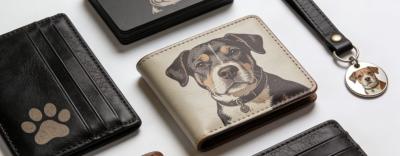
- wallets
- cable organisers
- card holders
- luggage tags
- bookmark straps
- AirTag holders
These products use very little material, ship cheaply, and feel highly giftable.
That combination matters enormously in the UK ecommerce market where postage costs continue rising.
Smaller leather accessories also photograph extremely well for social media.
And visual appeal drives a huge percentage of personalised gift sales now.
The Pet Market Is Quietly Huge
One niche that deserves far more attention is personalised pet accessories.
UK consumers spend enormous amounts on pets, especially dogs.
Leather dog collars, personalised tags, lead accessories, and travel pouches all fit naturally into this space.
What makes this niche particularly interesting is emotional buying behaviour.
People hesitate over expensive products for themselves.
They often spend impulsively on products for pets.And personalised pet products create strong repeat purchase opportunities because customers frequently buy gifts for fellow pet owners too.
This market also works brilliantly with minimalist leather aesthetics.
Simple names, clean fonts, subtle colours.
No need for complicated artwork.
Corporate Gifting Is More Profitable Than Most People Expect
Most small print businesses focus entirely on consumer sales.
Corporate gifting is often overlooked because people assume it requires large-scale production.
That isn’t always true.
Small companies constantly look for branded products that feel more premium than cheap promotional merchandise.
Leather accessories sit perfectly in that middle ground.
Not excessively expensive.
But significantly more professional than standard promotional products.Branded leather card holders, notebook covers, luggage tags, and desk accessories can create strong margins without huge production volumes.
And businesses are usually less price-sensitive than retail customers if the product feels polished.
The Biggest Mistake Beginners Make
Trying to scale too quickly.
Leather products reward experimentation.
The businesses that usually succeed are the ones that start narrow.
One product.
One aesthetic.
One target audience.Instead of launching twenty random personalised products, they build a recognisable style.
Maybe it’s minimalist travel accessories.
Maybe it’s personalised dog gear.
Maybe it’s wedding gifts.
Maybe it’s premium business accessories.The narrower the positioning initially, the stronger the brand identity becomes.
And in today’s crowded sublimation market, identity matters more than product count.
Why Leather Fits the “Slow Buying” Trend
Consumers are becoming more selective.
People still buy personalised products, but they increasingly prefer items that feel durable and intentional.
Cheap novelty printing still exists, but many customers are tiring of disposable products.
Leather naturally fits the opposite mindset.
It suggests longevity.
A personalised leather keychain feels like something you keep.
Not something you replace next month.That emotional difference changes purchasing behaviour more than many businesses realise.
You Don’t Need to Abandon Sublimation
This is probably the most important point.
Moving into leather-style products doesn’t mean abandoning sublimation printing.
The smartest businesses combine them.
They keep reliable bestselling sublimation products for stable income while gradually introducing more premium personalised items.
That balance works extremely well because:
- sublimation products offer scalability
- leather products offer differentiation
One drives volume.
The other improves brand perception.And when competition becomes intense, perception becomes incredibly valuable.
The Real Opportunity Isn’t the Material
The real opportunity is positioning.
Leather simply helps create a different type of product identity.
At a time when many personalised printing businesses are competing on speed and price, leather products allow smaller makers to compete on feeling instead.
That changes everything.
Because customers rarely remember who sold them the cheapest mug.
They remember products that felt meaningful.