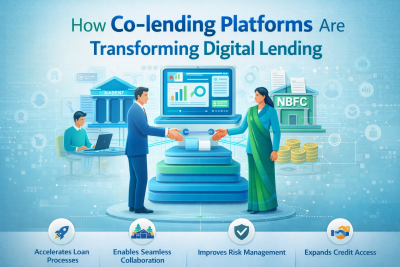
How Co-lending Platforms Are Transforming Digital Lending
-
Posted by Vikram Aditya Filed in Business #Co-lending Platforms #Co-lending Platform #Co-lending Software 99 views
The digital lending landscape is evolving rapidly, driven by technology, regulatory changes, and the growing demand for faster and more inclusive credit. One of the most significant developments in this space is the rise of co-lending platforms. By enabling collaboration between banks, NBFCs, and fintech companies, co-lending platforms are transforming how loans are originated, disbursed, serviced, and managed.
At Qualtechedge, we help financial institutions leverage advanced digital platforms to streamline lending operations. In this article, we explore how co-lending platforms are reshaping digital lending and why they are becoming essential for modern financial ecosystems.
Understanding the Co-lending Model
The co-lending model allows two or more financial institutions—typically a bank and an NBFC—to jointly fund a loan. Each partner contributes a predefined share of the loan amount while sharing risks and returns as per regulatory guidelines.
Traditionally, managing such partnerships involved complex manual processes, data silos, and reconciliation challenges. Co-lending platforms solve these issues by providing a unified, technology-driven framework that supports seamless collaboration across institutions.

What Is a Co-lending Platform?
A co-lending platform is a digital system that enables end-to-end management of co-lending operations. It integrates loan origination, credit assessment, fund allocation, disbursement, servicing, collections, accounting, and reporting into a single ecosystem.
Platforms developed by Qualtechedge are designed to support multi-partner lending models while ensuring transparency, compliance, and operational efficiency.
Key Ways Co-lending Platforms Are Transforming Digital Lending
1. Accelerating Loan Origination and Disbursement
Speed is a critical factor in digital lending. Co-lending platforms automate customer onboarding, KYC, credit evaluation, and partner approvals. This significantly reduces turnaround time and enables faster loan disbursement.
By eliminating manual handoffs between partners, lenders can offer near real-time credit decisions, improving borrower satisfaction and competitive advantage.
2. Enabling Seamless Collaboration Between Institutions
One of the biggest challenges in co-lending is coordination between multiple entities. Co-lending platforms provide a single source of truth where all partners can access real-time data related to loans, borrowers, and transactions.
This transparency builds trust between partners and ensures smooth collaboration throughout the loan lifecycle.
3. Improving Risk Management and Portfolio Diversification
Co-lending platforms enable lenders to diversify their portfolios by sharing risk across partners. Advanced analytics and rule-based engines help allocate loan portions dynamically based on risk appetite and regulatory norms.
With built-in monitoring tools, lenders can track portfolio performance, delinquencies, and exposure in real time, leading to better risk management and informed decision-making.
4. Driving Financial Inclusion at Scale
One of the most impactful benefits of co-lending platforms is their ability to expand credit access to underserved segments such as MSMEs, small retailers, and rural borrowers.
NBFCs and fintechs bring local market knowledge and alternative credit assessment models, while banks provide capital strength. Co-lending platforms combine these strengths, enabling inclusive lending at scale.
Role of Technology in Modern Co-lending Platforms
API-Driven Architecture
Modern co-lending platforms use API-based integrations to connect banks, NBFCs, credit bureaus, payment gateways, and core banking systems. This ensures smooth data flow and system interoperability.
Qualtechedge platforms are built with flexible APIs that allow rapid onboarding of new partners and products.
Automation and Straight-Through Processing
Automation is central to digital transformation. Co-lending platforms automate tasks such as:
-
Loan allocation between partners
-
Interest and fee calculations
-
Repayment schedules
-
Partner-wise accounting and reconciliation
This reduces errors, operational costs, and manual effort.
Advanced Analytics and Reporting
Co-lending platforms offer powerful dashboards and MIS reports that provide insights into loan performance, partner contributions, NPA trends, and compliance metrics.
These insights help lenders optimize strategies, improve collections, and meet regulatory reporting requirements efficiently.
Ensuring Regulatory Compliance and Transparency
Regulatory compliance is a major concern in co-lending arrangements. Co-lending platforms are designed to align with RBI co-lending guidelines, ensuring proper loan sharing, disclosure, and reporting.
Key compliance benefits include:
-
Automated partner-wise accounting
-
Transparent borrower communication
-
Audit-ready transaction records
-
Accurate interest and income sharing
Qualtechedge ensures that compliance is embedded into the platform, not treated as an afterthought.
Enhancing Operational Efficiency and Scalability
Manual co-lending processes do not scale well. As loan volumes grow, inefficiencies multiply. Co-lending platforms are built for scalability, allowing institutions to:
-
Handle large loan volumes
-
Launch new lending products quickly
-
Onboard multiple partners with ease
This scalability makes co-lending platforms future-ready for evolving market demands.
Co-lending Platforms and the Future of Digital Lending
The future of digital lending lies in collaborative ecosystems, not isolated institutions. Co-lending platforms are becoming the backbone of this ecosystem by enabling partnerships that balance speed, scale, and risk.
As technologies like AI, machine learning, and real-time data analytics mature, co-lending platforms will further enhance credit decisioning, fraud detection, and personalized lending experiences.
Qualtechedge continues to innovate in this space by building robust, secure, and configurable co-lending platforms that empower lenders to grow sustainably.
Conclusion
Co-lending platforms are fundamentally transforming digital lending by making collaboration simpler, faster, and more transparent. They enable banks and NBFCs to combine strengths, reduce risk, expand reach, and improve borrower experience—all while maintaining regulatory compliance.
For financial institutions looking to scale their digital lending operations, adopting a modern co-lending platform is no longer optional—it is essential. With its deep domain expertise and technology-driven approach, Qualtechedge is well-positioned to help lenders navigate this transformation and unlock the full potential of co-lending.
-
